
The order you already paid for: what a failed discount code really costs you.
August 26, 2026

A shopper fills a basket. They reach checkout, type in a discount code, and it is rejected. A good number of them simply leave.
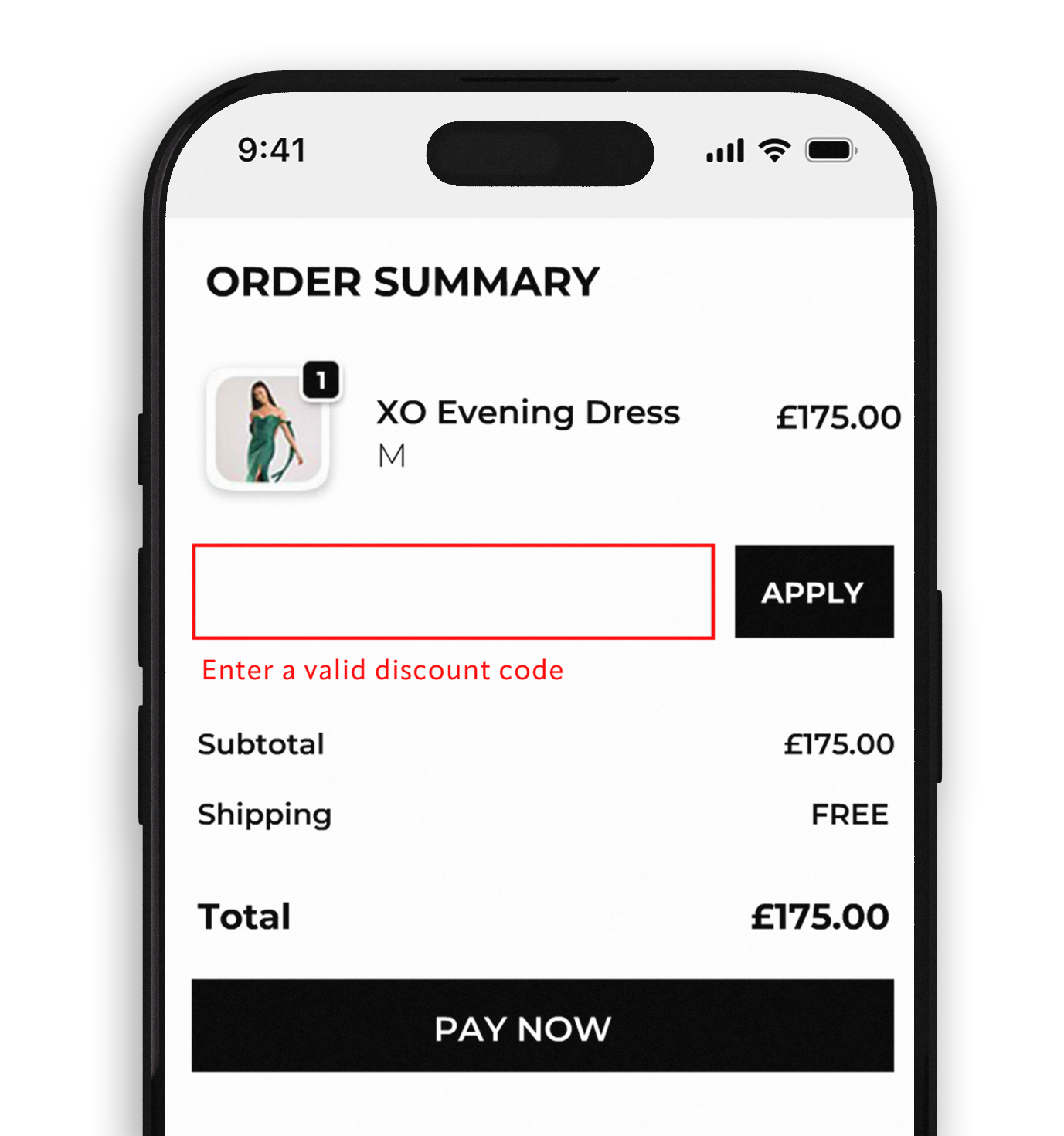
That moment costs more than you think. You have already paid to get that shopper to the checkout: the ad, the content, the email, the retargeting. They chose the product, added it to the basket, started to check out. Then one rejected code undoes all of it.
It’s easy to assume that a failed code is noise: a typo, an expired promo, a bargain-hunter who was never going to buy. But real checkout data says otherwise. When you look closely at what happens after a code is rejected, a failed code is a measurable conversion risk, and a recoverable one.
What counts as a failed code?
A failed code is a discount code the shopper entered that did not validate at checkout. It is shopper-entered and rejected, not a technical fault or a broken checkout. That’s a key distinction to note. A broken checkout is a bug to fix. A rejected code is a shopper telling you they wanted to buy and hit a wall, which makes it a recovery opportunity.
What the data shows
The Order Rescue app has visibility across a wider dataset of around 3 million checkout sessions across roughly 20 ecommerce merchants. For an independent read on it, this analysis was conducted with University College London (UCL), who ran a deeper analysis on three of those merchants: a sports and lifestyle apparel brand, a furniture and home retailer, and a fashion and apparel brand. Together those three cover at least 47,753 checkout records.
Three categories, three very different price points, and the same finding in each. Failed codes were leaving real money on the table, and much of it was recoverable.
£441,503 of order value rescued in the furniture dataset
£360,000+ of order value rescued in the fashion dataset
An overall rescued rate above 15% in the sports and lifestyle dataset in just a 3-month period
How the recovery works
Order Rescue runs on a simple mechanism. When a shopper enters a discount code that is rejected, it responds in the moment with a dynamically generated code that works. The order that was about to walk gets a second chance while the shopper is still there, basket full and intent intact.
A note on incrementality.
Rescued order value is not the same as fully incremental revenue. Some of those shoppers might have completed anyway. That is exactly why it should be measured rather than assumed, using a holdout or offer-off comparison that isolates the orders genuinely added. A rescue mechanism running live is what makes that measurement possible. The opportunity then becomes known rather than guessed.
What it means for your store.
Two things come back, not one. The first is the at-risk revenue itself, recovered at the checkout. The second is the intelligence underneath it: which codes shoppers try, where typos and expired promos create avoidable friction, and how higher-value or more persistent shoppers behave when a code fails. Most merchants never see that layer. It is hidden intent, surfaced at a commercially sensitive moment in the buying journey.
A failed discount code does not need to be the end of the order. Start by measuring what happens next.
Install Order Rescue on your Shopify store for free. Start in listening mode, even with no offer activated, and see what failed codes are costing your store.